


Last Updated: October 30, 2026
Quick Summary
Size portable power for camping by watt-hours, not wattage: list each device's watts times hours per day, total it, multiply by trip length, then add a 20% buffer. A typical two-night trip needs about 410 Wh, so shop in the 500 Wh range, and add 20-30% more for late-season cold.
- Wattage shows what a station runs at once; watt-hours show how long it lasts.
- A 500 Wh station recharging at 200 W of real input takes roughly 3 hours.
- Plan on 50-70% of a solar panel's rated wattage in real field conditions.
- Cold weather can block charging entirely until the station warms up.
- Confirm campground generator rules before buying one for your trips.
Table of Contents
- Start With Watt-Hours, Not Wattage
- Use a Camping Power Station Size Calculator
- Portable Power Station Runtime in Cold Weather and Real Trips
- How to Charge Devices While Camping Without Draining Your Bank
- Portable Power Station vs Generator for Camping
- Pick Your Power Setup Before Your Next Trip
- Frequently Asked Questions
Start With Watt-Hours, Not Wattage
Here's the number most campers ignore, and it decides whether your gear survives the trip: watt-hours. Portable power for camping trips lives or dies on capacity, not the big wattage number on the box.
Wattage tells you what a station can run at once; watt-hours tell you how long. A unit rated for 1,000 watts might hold only 500 watt-hours, so a 500-watt device drains it in about an hour.
The Three Numbers on Every Power Station Label
Every power station label lists three figures that matter more than any marketing badge:
- Watt-hours (Wh): total energy stored. This is your fuel tank.
- Continuous wattage: what the inverter can supply steadily without tripping.
- Peak power: a short surge for motor startup, usually lasting seconds.
Use a Camping Power Station Size Calculator
A camping power station size calculator is simple arithmetic: list each device, multiply its watts by hours used per day, add the totals, multiply by trip length, then add a 20% buffer for charging losses and cold-weather drain.
Here's how the math runs for a typical two-night trip:
| Device | Watts | Hours/Day | Daily Wh |
|---|---|---|---|
| Phone (2 devices) | 10 | 2 | 40 |
| LED lantern | 5 | 5 | 25 |
| Headlamp charging | 5 | 1 | 5 |
| Camera battery | 15 | 1 | 15 |
| Small cooler fan | 20 | 6 | 120 |
That's 205 Wh per day, or roughly 410 Wh for two nights. Add the 20% buffer and you're shopping in the 500 Wh range.
Portable Power Station Runtime in Cold Weather and Real Trips
Portable power station runtime drops in cold weather, and the drop is steeper than most campers expect. As temperatures fall, internal resistance rises, so the battery works harder to deliver the same current and wastes more energy as heat.
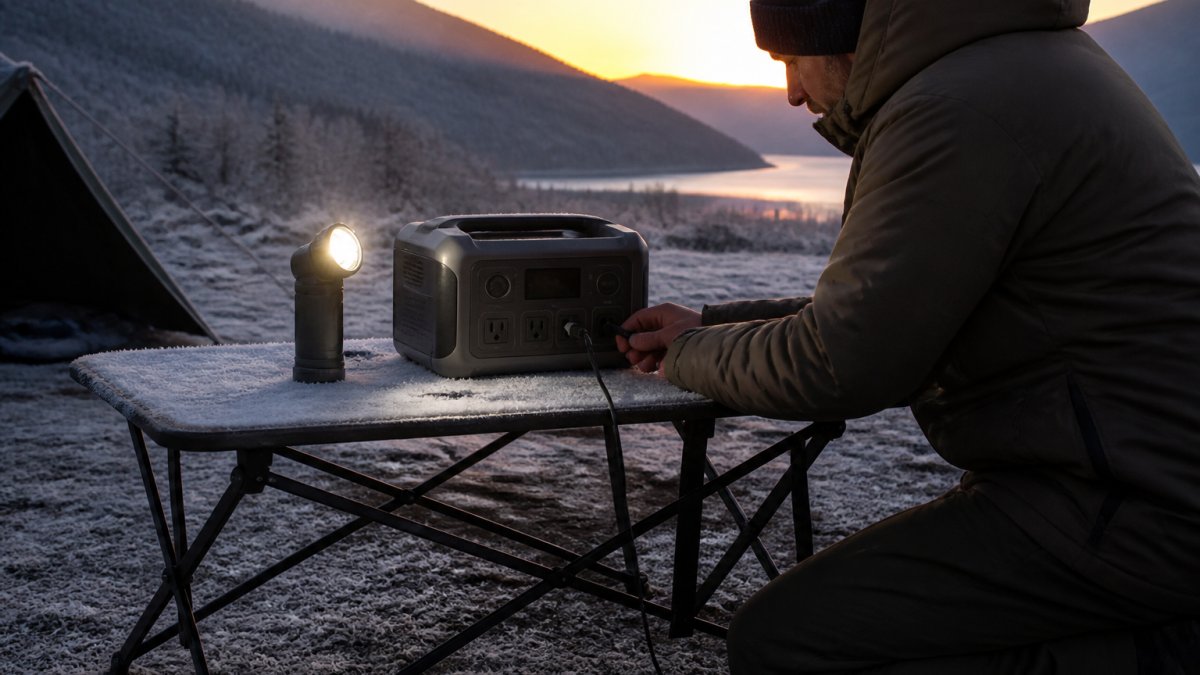
The effect varies by chemistry. Cold-weather capacity loss applies to lithium batteries in general, so check your unit's manual for its rated operating temperature range.
What Actually Happens Inside the Battery
Three mechanisms drive the cold-weather loss:
- Higher internal resistance: cold electrolyte slows ion movement, so voltage sags under load and the battery management system (BMS) may cut output earlier than in warm conditions.
- Reduced usable capacity: the BMS limits charge and discharge at low temperatures, so the station may report a lower state of charge than the cells actually hold.
- Charge blocking: most BMS units refuse to charge below a low-temperature threshold (commonly around freezing, though the cutoff varies by manufacturer). This is a protection feature, not a fault.
That last point catches campers out: plugging a cold-soaked station into a solar panel at dawn often does nothing until the unit warms up.
Cold-Weather Trip Scenarios
Here is how the derate plays out on real trips. These are planning estimates, not lab measurements, and you should check your own unit's manual for its operating temperature range.
| Trip Type | Overnight Low | Planning Adjustment |
|---|---|---|
| Early fall camping | 40-50°F | Little to no derate; plan normally |
| Late-season hunting camp | 25-35°F | Add 20-30% capacity buffer |
| Winter basecamp | Below 20°F | Add 40%+ buffer; keep station warm |
For a two-night trip that calculates to 410 Wh at room temperature, a late-season hunt at 30°F means shopping closer to 550-600 Wh rather than 500 Wh.
Practical Cold-Weather Tactics
Plan for the cold rather than fight it:
- Insulate off the ground. A foam pad under the station blocks conductive heat loss to frozen ground.
- Charge warm before you leave. Top off at home at room temperature.
- Store near your body heat overnight if the manufacturer allows it. Some campers use an insulated cooler with a hand warmer (never a direct heat source).
For hunters sitting long, cold hours, warmth and power go together. Practical tips on staying warm are in How to Stay Warm in a Tree Stand All Day.
How to Charge Devices While Camping Without Draining Your Bank
Charging devices while camping comes down to three inputs: solar, AC, and DC. Match the input to your trip style, and to the recharge time you're willing to wait.
KILLZ TORCH Z FLASHLIGHT w/ POWER STATION-SUMMER SPECIAL →
The Three Inputs, Compared
| Input | Typical Input Wattage | Best For | Main Trade-Off |
|---|---|---|---|
| AC wall outlet | 100-500 W (varies by unit) | Pre-trip top-off, basecamp with shore power | Requires an outlet; not available in the field |
| Solar panels | 60-200 W per panel (varies) | Multi-day trips with sun | Slow, weather-dependent, angle-sensitive |
| DC carport (12V socket) | 100-120 W typical | Travel days between spots | Only works while driving or idling |
Those wattage ranges are typical, not universal, check your station's rated input before buying panels or cables. A 500 Wh station recharging at 200 W of real input takes roughly 3 hours with efficiency losses; at 100 W of solar, the same station needs 5+ hours of good sun.
Sizing Solar for a Real Trip
Solar is the input most campers get wrong. A panel rated at 100 W rarely delivers 100 W in the field, angle, haze, tree cover, and heat all cut into it.
To size solar, divide your daily watt-hour need by realistic sun hours. A 205 Wh/day load with 4 good sun hours needs about 50 W of realistic input, so a 100 W panel gives margin for clouds and angle losses.
Ports and Pass-Through Charging
Pass-through charging lets you run devices while the station recharges, but not every station supports it at full output, and some throttle output while charging. Check the manual before relying on it for a fridge or CPAP.
Match your ports to your devices before buying:
- USB-C PD handles phones, tablets, and small electronics efficiently, often at 30-100 W depending on the port's rating.
- USB-A covers older devices and small accessories.
- 12V DC carport / cigarette-lighter style runs coolers, fans, and vehicle accessories.
A station with the wrong port mix forces adapters you'll lose in the truck. Count your devices and plug types before comparing units.
Charging Devices Without Draining the Bank
The cheapest watt-hour is the one you never spend. A few habits stretch a station across a trip:
- Charge phones during the day from solar or the car, not overnight from the station.
- Use low-draw LED lighting instead of running an inverter for light.
- Turn off the inverter when not in use, idle inverter draw adds up over a multi-day trip.
Portable Power Station vs Generator for Camping
A portable power station vs generator for camping decision usually favors the station for most trips. Generators produce more sustained output and run on fuel, but they're loud, emit exhaust, and many campgrounds restrict them.
Generators win when you need high-draw appliances for extended periods. A reader who wants a bundle can look at the KILLZ TORCH Z FLASHLIGHT w/ POWER STATION-SUMMER SPECIAL. The KILLZ TORCH Z Flashlight with Power Station ($15.00) pairs a rechargeable 1,500-lumen light with a built-in cell phone charger and a LIFETIME manufacturer warranty.

Watch out: buying a generator for a campground that bans them leaves you with dead weight and no backup plan. Confirm site rules before you commit.
Pick Your Power Setup Before Your Next Trip
Run the calculator, check the label for watt-hours, and size up one buffer tier. Readers ready to choose can view the Powerlite Versa as a power station option. If you want a station built to match it, the Powerlite Versa ($14.99) is a rechargeable option worth a look for camp lighting.

Killz Products, LLC. offers gear built for outdoor conditions, including the Powerlite 3 in 1 Rechargeable Flashlight, which has rugged aluminum construction, an IP65 / IPX5 waterproof rating, an integrated power bank, and a 5-Year Warranty.
Shop Now and head out with power you can actually count on.
Frequently Asked Questions
What size portable power station do I need for camping?
Most weekend campers do well with 300 to 500 watt-hours, which covers phone charging, a few headlamp top-ups, a lantern, and a small fan or camera battery. Add up each device's watts multiplied by the hours you run it, then add 20 percent for inverter losses. If you bring a portable fridge or run a CPAP machine, move up to 700 to 1,000 watt-hours. Match the continuous wattage rating to your biggest single device, not the total.
How long will a portable power station last on a camping trip?
Runtime depends on load, not trip length. A 500 watt-hour unit running a 50-watt load lasts roughly 10 hours before efficiency losses, closer to 8.5 in practice. Charging a phone takes about 0.02 kilowatt-hours per full charge, so the same unit handles dozens of top-ups. Cold weather cuts usable capacity, so plan on 70 to 80 percent of the rated figure when temperatures drop below freezing.
Are portable power stations better than generators for camping?
For most campsites, yes. Power stations run silently, produce no exhaust, and are allowed where fuel generators are banned. They also weigh less and need no fuel storage. Generators still win for high-draw appliances over multi-day base camps, where a 2,000-watt unit can run a space heater or hot plate. For lighting, phones, and small electronics, a power station covers the job with less noise and maintenance.
Can a portable power station be charged with solar panels?
Yes, if the panel's voltage and connector match the station's solar input rating. Check the maximum solar input wattage on the spec sheet and stay at or below it. A 100-watt panel realistically delivers 50 to 70 watts in good sun, so a 500 watt-hour station needs most of a clear day to refill. Pair solar with a wall charge before you leave so you start every trip at full capacity.


