


Last Updated: November 1, 2026
Quick Summary
Yes, mechanical broadheads penetrate bone, but only under the right conditions. They punch through ribs with little trouble yet struggle more on the thick scapula and shoulder joint, where design and arrow setup decide the difference.
- Blade deployment costs energy, and on hard bone the blades can stall before fully opening.
- Fixed-blade broadheads have no deployment step, giving them an edge on heavy bone.
- Heavier arrows carry more momentum into bone, and momentum matters most on hard impacts.
- A square hit drives through the scapula while an angled hit deflects.
- A broadside double-lung shot behind the shoulder is commonly cited as a strong target.
Table of Contents
- How Mechanical Broadheads Perform on Bone
- Fixed Blade Broadhead Bone Penetration: What the Contrast Reveals
- Inside a Mechanical Broadhead Penetration Test
- Broadhead Shoulder Blade Penetration: Limits and Design Solutions
- Mechanical Broadhead Shot Placement for Ethical Hunts
- Choosing Bone-Capable Broadheads for Your Setup
- Frequently Asked Questions
How Mechanical Broadheads Perform on Bone
Do mechanical broadheads penetrate bone? Yes, but only under the right conditions. Achieving this level of performance requires a balanced setup, which is why understanding the fundamentals of your equipment is essential before consulting an archery gear guide.
Bone is not one material. A deer's rib is thin and curved. The scapula is a wide, flat plate. The shoulder joint is a dense ball of heavy bone. Each one treats a broadhead differently.
A mechanical broadhead is an arrowhead with blades that stay folded in flight and open on impact. That folding action is the whole story.
The short version: mechanical heads punch through ribs with little trouble. They struggle more on the thick scapula and shoulder joint. Design and arrow setup decide the difference.
Rib Cage and Scapula: Two Very Different Impacts
A rib is a glancing problem. It is narrow, and a sharp head often slips between or through ribs with modest energy loss. A scapula is a wall. It is broad, hard, and angled, and it absorbs far more momentum.
Hunters who report clean pass-throughs on rib hits sometimes report a stuck arrow on the same deer's shoulder. Same bow, same head, different bone. That is not inconsistency. It is physics.
Watch out: aiming "a little forward" to catch the shoulder is one of the most common causes of a non-pass-through on an otherwise good shot.
How Blades Deploy and Where Energy Goes
Blade deployment costs energy. When mechanical blades open, they pull momentum out of the arrow to swing outward and cut. On soft tissue that cost is small. On hard bone, the blades can stall before they fully open.
This is where design matters. Zeus heads use Bone Reactive Blades Technology: the two main blades collapse down on bone contact, then reopen and punch forward while maintaining forward momentum.
Field-point accuracy matters here too. A head that flies true hits where you aim, and a well-placed hit matters more than the head itself.
Fixed Blade Broadhead Bone Penetration: What the Contrast Reveals
Fixed-blade broadheads have no deployment step, so no energy is spent opening blades. That gives them an edge on heavy bone. Fixed-blade heads can drive through heavy bone with less energy lost to deployment.
But fixed blades give up something. They are less forgiving in flight, and large fixed heads can steer off course at distance. The trade is real: better bone penetration against better accuracy and a wider cut.
Here is the general contrast:
- Fixed blades: stronger on shoulder and heavy bone, less forgiving in flight.
- Mechanicals: field-point accuracy and a wider wound channel, more sensitive to energy and angle.
Neither type is "best." The right pick depends on your setup and where you expect to hit.
Inside a Mechanical Broadhead Penetration Test
A useful mechanical broadhead penetration test is repeatable. Same bow, same arrow weight, same distance, same target material. Change one variable at a time and record what happens.
Most hunters never run one. They rely on a single deer and a strong opinion. That is how myths spread.
If you want to test for yourself, keep it simple:
- Use a layered foam or ballistic gel block that mimics tissue and bone density.
- Fire three shots per head at the same distance and log pass-through or stop depth.
- Test rib-thickness and scapula-thickness barriers separately.
- Note blade condition after each shot.
The Archery Trade Association safety and equipment resources cover sound testing and hunting practices worth reviewing before you head out.
ZEUS BROADHEADS OG (3 PACK) 100gr or 125gr →
Arrow Setup Variables That Change the Result
Your arrow setup drives penetration more than many hunters realize. A light, fast arrow and a heavy, slow arrow behave differently in bone.
Key variables:
- Arrow weight: heavier arrows carry more momentum into bone.
- Kinetic energy and momentum: momentum matters most on hard impacts.
- Draw weight and bow setup: more stored energy means more impact velocity.
- Broadhead design: blade retention and ferrule strength decide how much energy reaches the target.
A common mistake is chasing speed with a very light arrow, then blaming the broadhead when it stops on a shoulder. For a deeper guide on tuning broadheads to fly like field points, see Broadheads That Fly Like Field Points: A Tuning Guide. Fix the arrow first.
Broadhead Shoulder Blade Penetration: Limits and Design Solutions
Broadhead shoulder blade penetration is the hardest test most hunters face. The scapula is thick, angled, and dense. A mechanical head can get through it, but the margin is thinner than on a rib.
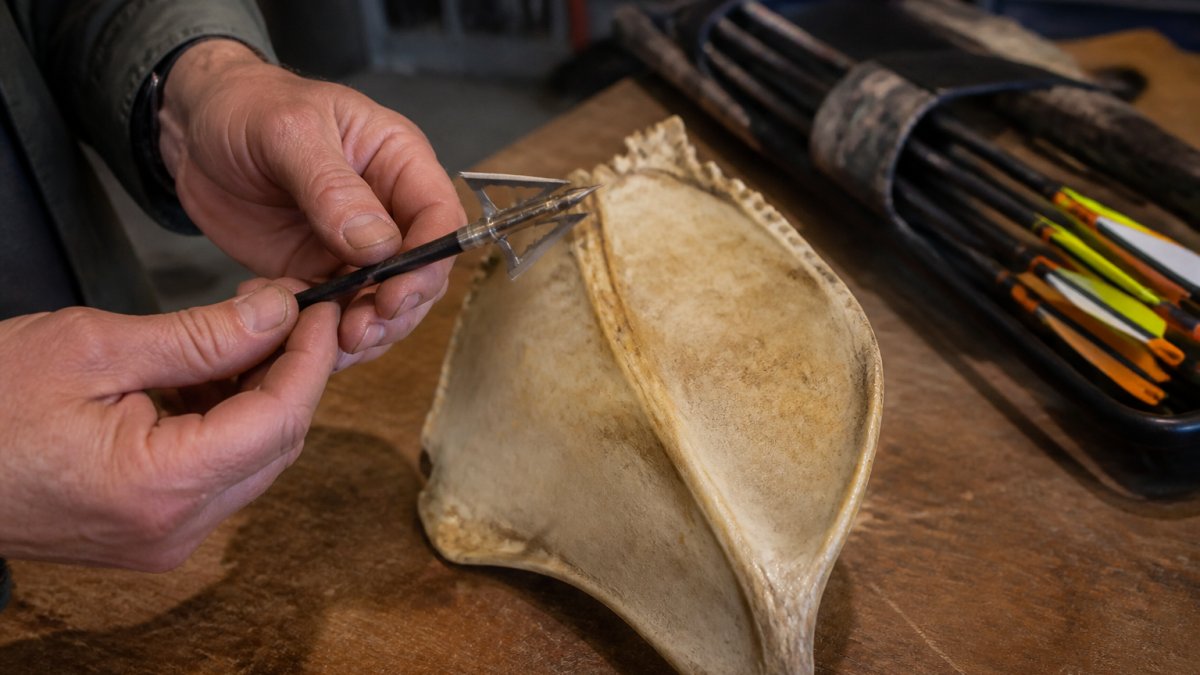
Three things decide the outcome:
- Impact angle: a square hit drives through; an angled hit deflects.
- Ferrule and blade strength: weak materials break or bend on hard impact.
- Energy at impact: a marginal setup stalls on the scapula.
Blade breakage is the failure mode to watch. The ZEUS TITANIUM BROADHEADS (3 PACK) PLUS PRACTICE HEAD use a titanium ferrule and hardened stainless blades, with Bone Reactive Blades that collapse on bone and reopen to keep cutting forward.

A word of caution: no head guarantees a pass-through on a square shoulder hit from a light setup. Design raises your odds. It does not erase physics.
Mechanical Broadhead Shot Placement for Ethical Hunts
Mechanical broadhead shot placement is often discussed as favoring the rib cage over the shoulder, and a broadside double-lung shot behind the shoulder is commonly cited as a strong target for any broadhead.
Ethical hunting means matching your shot to your equipment. If your setup is marginal on energy, do not take the shoulder shot. Wait for the broadside or quartering-away angle that puts the arrow through ribs and lungs.
Plan for the wait. Long sits in cold weather test your patience and your focus, and staying warm helps keep you steady for the right shot. How to Stay Warm in a Tree Stand All Day offers practical advice for the wait.
Choosing Bone-Capable Broadheads for Your Setup
Choosing a bone-capable broadhead comes down to matching the head to your bow, your arrow, and the shots you actually take. Start with your energy and momentum, then pick a design that holds up on hard impact.
If you want a mechanical head built for bone contact, the catalog includes these options:
- ZEUS BROADHEADS OG (3 PACK) 100gr or 125gr at $32.99: Bone Reactive Blades, a 1 1/2" cut with 7/8" bleeders, and a bone-crushing ballistic tip. Compatible with compound bows and crossbows.
- ZEUS APOLLO BROADHEADS (3 PACK) 100gr or 125gr at $29.99: Bone Reactive Blades, a 1 1/2" cut, and field-point accuracy.
Both are listed with GrainShift 100gr or 125gr tips. Consider these factors when deciding:


| Your Situation | What to Prioritize | Why |
|---|---|---|
| Marginal energy setup | Heavier arrow, bone-reactive head | Preserves momentum on impact |
| Broadside rib shots | Field-point accuracy | Hits land where you aim |
| Occasional shoulder risk | Strong ferrule, blade retention | Survives hard impact |
| Crossbow hunting | Compatible head, tuned weight | Consistent flight and energy |
For broader context on head types, the quality hunting and conservation standards from state wildlife agencies are a useful reference on ethical take and equipment rules.
A final caution: field anecdotes are not a reliable measure. One deer and one shoulder hit describe a single result, not what your setup will do. Test, tune, and pick a head that fits your bow.
Frequently Asked Questions
Can mechanical broadheads penetrate bone?
Yes, mechanical broadheads can penetrate bone, but the result depends on the bone and the setup. Ribs are thin and usually pass without issue. A shoulder blade or shoulder joint is a different test. Broadheads with bone-reactive blades, like the Zeus line from Killz Products, have main blades that collapse on bone contact and reopen to keep cutting forward. Even so, a hard angled shoulder hit can stop any broadhead, so shot placement still matters most.
Are fixed-blade broadheads better for bone penetration?
Fixed-blade broadheads have no deployment step, so they lose no energy opening blades on impact. That gives them an edge on hard, angled bone such as the scapula. Mechanical heads make up ground with larger cutting diameters and designs that fold blades back on bone. The right answer depends on your arrow energy and shot angle. Many hunters carry fixed blades for quartering shots and mechanicals for broadside rib-cage shots.
What happens when a mechanical broadhead hits a shoulder blade?
A shoulder blade hit is one of the toughest tests for any broadhead. The blade must cut through flat, dense bone at an angle, and much of the arrow's energy goes into that cut. A standard mechanical head may stop short of the vitals. Designs with bone-reactive blades and a titanium ferrule, such as the Zeus Titanium, collapse blades on bone and reopen to keep cutting forward. Even then, a steep quartering-away angle can defeat the shot, so aim behind the shoulder when you can.
Where should you aim to avoid hitting bone with a mechanical broadhead?
Aim for the lower third of the rib cage, just behind the shoulder crease. That path misses the scapula and the shoulder joint and gives the broadhead a clean route to the heart and lungs. On a quartering-away deer, tuck the pin behind the last rib so the arrow exits through the opposite shoulder area without a hard bone hit. Broadside and slightly quartering-away shots produce the most pass-throughs with mechanical heads.
Bone penetration is not luck. It is energy, design, and shot placement working together, and most hunters only control two of the three. We build Zeus broadheads to give you the design advantage, with Bone Reactive Blades that collapse on bone and reopen to keep cutting, field-point accuracy, and a bone-crushing ballistic tip. Get started with Killz Products, LLC. and put a head on your arrow that is built for the shots that matter.


